The quantity of quality beaches nearby Lisbon, not to mention in Portugal, is overwhelming. You can have a glimpse of how it is like to wander around the country beach tasting/testing but the sites I will present here will maybe cover 1% of the total number.
Costa Caparica is probably the hippest beach in the Lisbon’s surrounding. The fact is, it is pretty much accessible, either by car, or by bus taken from the centre of Lisbon. Be aware if travelling during rush hours: the beach is situated on the other side of the Tejo river, and the famous Ponte de 25 de Abril at that times become rather a parking lot than an artery.
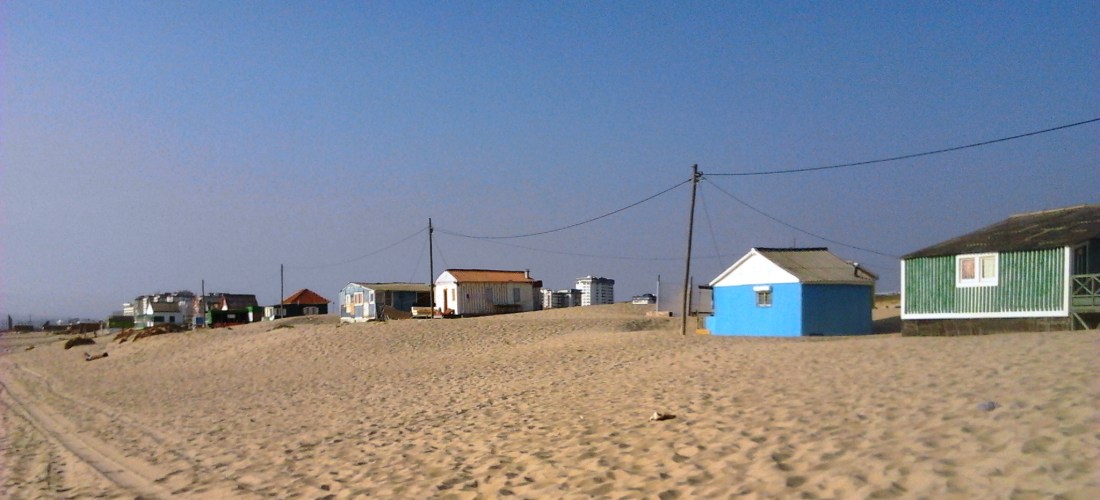
Once you get there, you will notice various beach bars and restaurants, varying from very posh to quite affordable ones. But what actually is my favourite remark of the Caparica beach is the quantity of surfing schools and little, wooden houses which endured wind, sun and high tides.
There is pretty much everything to be found on this wide beach: also a nudist and gay zone aka Praia 19. However, if you are looking for a rocky beach where to hide from the all-time present sun and humanity, Caparica may not be the best choice.
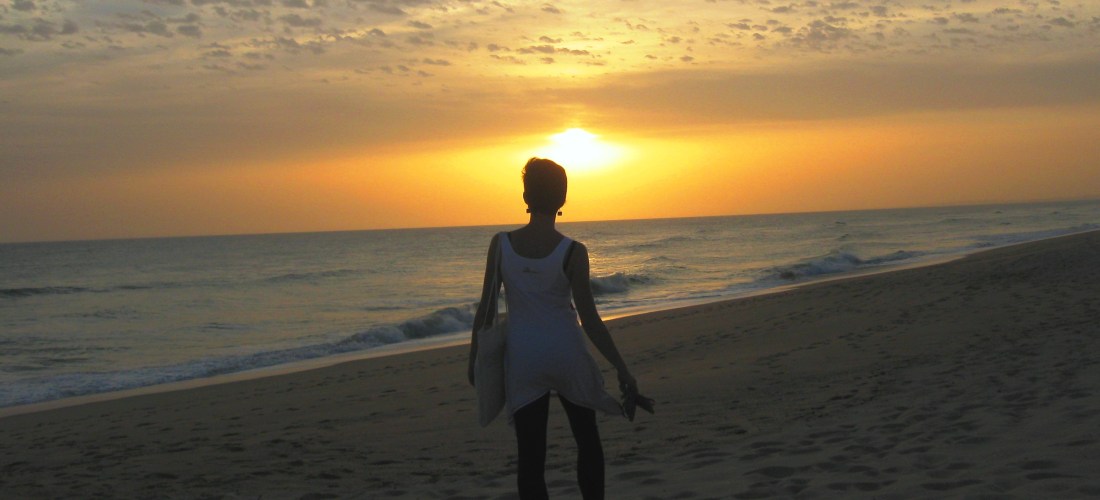
My personal fave is to sit nearby the wooden houses, listening to bossa nova classics overlooking the sunset and think about what memories I have left on the other side of the Atlantic Ocean. I think that what Principezinho meant by ‘looking at the sunsets’ while being melancholic, the Portuguese put nicely in one keyword: saudade.
Wiki:
Ponte de 25 de Abril – 25th of April Bridge, connecting the city of Lisbon with the municipality of Almada on the left (south) bank of the Tejo river. The name “25 de Abril” commemorates the Carnation Revolution.
Principezinho – The Little Prince of Saint-Exupery
Moving on with the Lisbon-related delights… I need to present you the beach I fell in love with at a first sight and which remains in my top 5 until now. Moreover, which is within 1 hour drive reach from the Portuguese capital’s centre!
I have to travel back to very difficult 2011 when Lisbon has been my departure and arrival point throughout the year. Eventually, when my first Brazilian/South American travel came to an end in the mid-September, Lisbon was my welcoming port in Europe after a few months of absence. I had a very emotional meeting with my Mom and my cousin Piotr who decided to fly over from Berlin to join me and spend a couple of days in the Cidade da Luz.
Tired after all-night travel, I proposed we should chill out at the most peaceful place I know by the Oceanside: Praia do Guincho. It was not so easy to get there, taking train to Cascais and then a bus, but impossible was nothing on that very special day for us, weary travelers.
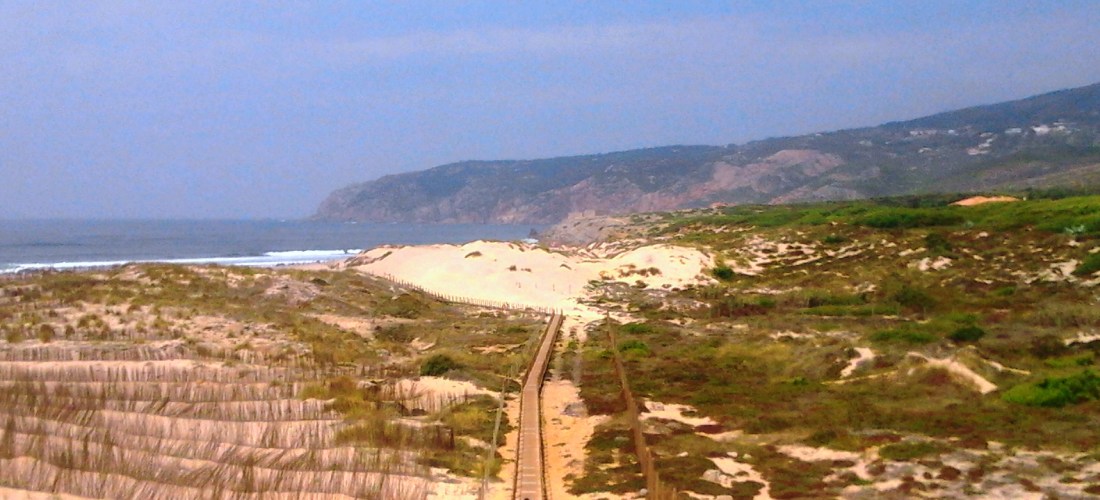
And then, the path between the dunes and green Atlantic forest led us to a wide, sandy beach limited by the most-Western rocks within the continental Europe: Cabo da Roca tip. The air was so clear, the waves – high and long and the breeze was making wonders to my jet-lagged body and soul. We were so happy there, we could not even realize that the tide went up very quickly, gathering back to the ocean our camera, sunscreen and what not. No quality photos were left from this lovely Indian Summer get away, but the memories will definitely remain. And this Brazilian-origined song can tell how glorious can it be when you live by the sea.
Wiki:
Cidade da Luz – City of Light, Lisbon’s nickname
Cabo da Roca – ‘Rocky tip’, the most Western tip of the continental Europe
Last days of summer in Europe simply ask for transmitting some uplifting and boogie beats. Fortunately, there are places on Earth, where summer is a state of mind, not just a season. As mentioned before this is the case in the North-Eastern Brazil, be it August or February. European places cannot a comparison to its tropical climate, but I remember some 50 degrees differences between my hometown in Poland and in the South of Portugal where I used to live during a couple of months (-25 vs. 25 Celsius degrees).
Algarve, as we speak, is the most popular region in Portugal among tourists and surfers, but apart from some horrendous towns famous for being actually nothing more than ‘Nordic colonies’ it is indeed a region famous for some best beaches in Europe. From my experience, I would definitely recommend one-of-its-kind islands nearby the rivalry towns Faro and Olhão (like the Ilha Deserta or Ilha do Farol) for those who love endless sand-scapes. On the other hand, beaches located nearby Sagres or Aljezur are amazingly rocky and the waves are the best for those who love to surf more than anything else. The windward site is still considered to be less affected by the massive tourism, and if you have enough time, visiting sites in the Sud Oeste Alentejano National Park is a brilliant idea. However, for bird-watching aficionados, like my friend Krzysztof (for Polish speakers I recommend his hillarious blog about ‘the ones that fly’ http://volucrescoeli.wordpress.com) the leeward coast would be a delight, due to various deltas and natural reservoirs of Ria Formosa National Park for flamingos and storks, to name very basic few. More about Algarve to come, yet to illustrate its sunny, sandy and summery wonders I chose one of my fave remixes of DJ Marky, about what’s beyond the sea.
Wiki:
Além do mar – beyond the sea (taken from the Djavan’s – Nereci, one of the Brazilian classic’s lyrics)
Coming back from short holidays, I am quite puzzled if I really had to return to my usual urban life. Well, life is life – as one particularly insightful song told us in the 80s.
Thinking of some best moments of my life, I am normally reminiscing special people or places and this being especially helpful upon arrival to somewhat regular and down-to-earth reality. Undoubtedly, one of the moments of perfection I lived was in the North-Eastern tip of Brazil, on the outskirts of the city Natal, the capital of the Rio Grande do Norte region. Famous for its enormous dunes and never-ending, unspoiled beaches. Despite from becoming increasingly touristic destination, it has preserved most of its natural highlights.
I was lucky enough to rent an apartment on the Ponta Negra beach just at the tip of the Morro do Careca, the emblematic dune of the city. It used to be a lively spot for the locals in the past where they used hang out to sandsurf, but due to the risk of destroying the dune, the access has been lately cut off and the neighbourhood become surprisingly quiet.
These days, overlooking the sun or the moon in the Old Town port from my Barcelona loft, I often remember the magic nights of bathing in the Ocean, spotted by the moonlight, and burning torches from local beach bars where fresh caipirinha was completing the state of alegria. There are countless songs about this state of mind, but no one described it better than Gal Costa, in Pontos de Luz. Sun, the moon, the sky…
alegria – happiness
caipirinha – a popular Brazilian-origin cocktail, made of cachaça (sugar cane hard liquor), sugar and lime
Em fevereiro tem carnaval… not only in Brazil! The cultural heritage between Portugal and Brazil is not only a matter of centuries – long colonial, complex relationship but also a matter of nostalgia and, once again, saudade.
So this year for a very short winter break, I pointed the Madeira Island as a destination. As it was known to me as the best place to spend the carnival outside of Rio de Janeiro or Salvador de Bahia (oh well, let’s not enter into the discussion which one is better…), I had to live the experience. And I was not disappointed, actually it surpassed greatly my expectations.
Madeira Island, a part of the autonomous overseas territory of Portugal is situated in the Northern Atlantic Ocean, and its archipelago consists also of the paradise-beach Porto Santo Island and Deserted Islands, which have no residents, as the name suggests. It is famous for its all-year long mild microclimate oscillating around 20-25 Celcius degrees and variety of flora and fauna. It is true that within one day one can experience 4 seasons, go to the beach, hike in the mountains or simply breathe the unbelievably clear air with flowery scents.
The carnival though is a special day for the Madeirenses, the inhabitants of the island. Just to mention that this island was for a long time a strategic location for the overseas travels and during the centuries it gathered not only Portuguese descendents, but also Brazilian and Venezuelan. They are very proud of their autonomous status and they also developed a very specific sotaque so to say. For the Saturday parade it takes much effort to prepare the samba groups costumes, sambadromos, choreography and what not! This year’s (2014) topic was the Sparkling Carnival and indeed, after a few hours of participating in the parade show, my eyes were wide shut/open with amazement. You can experience some of it having a look at the video attached. More happy and flowery posts about Madeira tbc!
Wiki:
carnaval na ilha – carnival on the island
“Em fevereiro tem carnaval” – “we have carnival in February” a famous phrase from the popular song “Pais Tropical” (“Tropical country”) telling the numberless advantages of life in Brazil
sotaque – accent
sambadromo – a place, normally a platform to show the performances of the samba schools during the carnival time
Yes, this post is dedicated to water, and the bossanova classic. But as a matter of fact, it is mostly about Brasilia, the capital of Brazil where I lived for a couple of months.
It was there where I learn for the first time, quite strikingly, how important is to water yourself properly. This fascinating yet quirky capital built in 1960s in the middle of planalto is famous for two remarkable seasons (and two mejor neighbourhoods only, anyway – shaped as wings of a plane). The humid one starts sometime in October and lasts until April and meanwhile, the word ‘chuva‘ disappears from the BSB vocab. Residents claim that even though the showers may be abrupt and heavy, this is when their city springs with the sheer beauty. I did not have a chance to see it though. Arrived in the beginning of July, thinking in terms of the European standard four seasons, I could not expect the winter to be represented by constant sunlight, 34 Celsius degrees and humidity dropping down sometimes below 15%. During my first days I realised it is not an exaggeration that one have to carry a bottle of water 24/7. I also discovered some of my faves: Água de coco, the coconut water which I misspelled awkwardly at the beginning, to my Brazilian friends’ amusement (see Wiki).
Fair enough, the cheerful bossanova classic had to come to my mind. Comparing love to water may not be so original, but is very sensual and is somewhat typical for various MPB artists. Surely tbc in some other occasion.
Wiki:
Água de beber – water to drink, a title of the bossanova classic written by Tom Jobim and sung by Astrud Gilberto
BSB – abbreviation for Brasilia
chuva – rain
coco – coconut
cocô – shit (yes, if you put an accent on the second ‘o’ when asking for the coconut water, you will make Brazilians laugh a lot)
A city which never sleeps and which could easily be a self-sufficient country itself with over 20 millions of residents and participation in about of 40% of the Brazilian GDP. A centre of the world for many, and the most important business location in LATAM. Love it and hate it at the same time, São Paulo has gained its fame as the ‘true capital’, where the most important economic and cultural events and processes take place and is literally bustling with the multicultural spirit. It is much different from what one would expect from a typical Brazilian postcard. Rather, one can expect anything and be sure this city will not leave you cold. From almost 2 million Japanese neighbourhood, making it the largest community outside of Japan, through exciting clubs and bars, to last remains of nature hidden somewhere in the concrete jungle (like Ibirapuera Park, for instance). Also, contrary to fantastically boring sunny climate typical for the most part of the coastline part of Brazil, São Paulo has a very changing weather and seeing the sun through the smog and skyscrapers may not be so easy.
The is no better LP which would illustrate the all-time changing urban soundscape of SP, recorded by the late Serbian-origin producer Suba – São Paulo Confessions. This producer came back in the late 80s and got sucked in by the city and the Brazilian culture. Tracks like ‘Samba do Gringo Paulista’ or ‘Tantos Desejos’ became electronic music classics and great material for remixes.
It is difficult to get to know Sampa within a few days, and I regret not having had more time to explore it. It literally takes hours to travel from one part of the city to another, not to mention commuting between the airports which are based in three very distant locations. However, it seems that neither a majority of residents of SP are not familiar with their city, spinning in a wheel of the crazy drive. Blinded by the lights on the famous Avenida Paulista, the urban excitement leads to artsy Vila Madalena and on and on… Getting out of the stimulating SP state of mind may be equally challenging.
This time I would like to focus on the meaning that Brazilian artists had on the evolution of the drum and bass style. The discovery of the Brazilian d’n’b in my case coincided with the first clubbing experiences sometime around 2001. Based in the city half-way between Berlin and Warsaw, I remember these days were quite inspirational. There was an interesting drum’n’bass movement in the Polish capital, before the clubbing scene went mostly handbag, and it inspired some smaller cities like Poznań to create various underground places in the Old Town. It was also the year of releasing a very influential mix: DJ Marky’s Brazilian Job. I bet I heard it for the first time in the legendary Radiostacja alternative radio programme, in the late-night show ‘Drum and bass cały czas’ and it knocked me literally off my feet!
DJ Marky is already a living legend of the Brazilian electronic music, together with DJ Patife, Drumagick, and on a lighter note: Kaleidoscopio, to name very few who added an important value to what has already been discovered in the UK. The title of the post comes from a remarkable compilation which gave to the world some of the all-time relevant anthems like Fernanda Porto’s ‘Sambassim’ or ‘So Tinha de Ser com Voce’ remixes.
They firstly revolutionized the scene throughout Brazil, starting off in Sampa (aka SP, Sao Paulo), and later on in the UK (with DJ Marky’s residence at The End and recently in Fabric London). In the first decade of the 2000s Brazilian d’n’b became truly an exportation good.
Even if nowadays d’n’b became just a marginalised part of the ‘bass’ music, I still admire the unique style of combining the Brazilian classics with the energetic beats. The Brazilian d’n’b golden age was so powerful as if the music was to describe the high hopes spirits of those years. This spirit I found nowhere else, but in the North-Eastern region of the country, contrary to the statistics. Most of the cities in the region are still struggling with violence, uncontrolled urbanization processes and poverty, but each year the conditions are improving thanks to the economic development and the politics introduced in the era of the President Lula da Silva. To me, Brazilian d’n’b pictures the changes in the North-Eastern region, with some of the most impressive beaches, cuisine and weather for surfers on Earth, approximately 365 days of sun and wind per year and still, with some striking poverty and inequalities. In my humble opinion, Brazilian d’n’b, full of energy, yes-we-can attitude and creativity, should become a national musical product to share and promote the country, to top up with samba and bossanova.
During those last couple of years I was close to consider myself as a frequent transatlantic flyer from the Lisbon’s TAP airlines hub. Be it Brazil, be it Madeira, be it any South American destination, Lisbon has been just a good connection point from the Iberian Peninsula, not as crowded as Madrid Barajas and offering very interesting direct connections with the South American and African continent.
The idea for this first within the series of posts is generated by my curiosity about the cross-Atlantic influences between the postcolonial Portuguese-speaking countries. This one would be about the Angolan presence in a modern-time Portugal and Brazil.
When living in Lisbon, my attention was not only attracted by the local culture, but rather by the overwhelmingly rich mix of the Afrolusobrasilian influences. This is where I learned my first kizomba steps, and where I discovered some underground places in Bairro Alto serving kuduro music as their main dish. Back in the day, 2008/2009-ish kuduro became a world’s electronic music fetish, as well, so I had a feeling I am in the centre of the world.
The most famous kuduro team, Buraka Som Sistema dedicated quite a lot of their tracks to describe the Angolan presence in Lisbon, with the anthem ‘Luanda Lisboa’
Angolan influence is also very visible in the Bahian culture of Brazil, with the richness of the Candomblé religion. For instance, in the 70s, a lot of MPB artists, such as Claudia with her ‘Ossain’, performed their songs based on the traditional lyrics, chants and traditions of this religion:
However, since the difficult crisis years commenced in Portugal, well, in all the Southern Europe in general, the migration tendencies seem to change. Each day several planes leave at least Lisbon’s airport in the Luanda’s direction. Not only the 2nd or even 3rd generation of the Angolan descendents in Portugal search for their professional careers in this African land of promise, but also the Portuguese and the Brazilians. Luanda nowadays is one of the most expensive cities to live in, but the salaries for the expatriates and contracted high-level employees seem to be also one of the most attractive in the world.
I did not have a chance to travel to Angola so far. However, I feel very tempted to do so given its rich culture and complex history. Still, unstable politics, striking inequalities in the distribution of goods seem to be a pain in the neck for a daily life of the Angolans. I hope to get back with some more insightful post shortly, maybe when I finally book the trip: Lisboa – Luanda…
Wiki:
Bairro Alto – a neighbourhood in Lisbon famous for cosy bars and small underground cultures clubs, a night life centre of the city
kuduro – is a type of music and dance originally developed in Angola in the 1980s, became popular worldwide around 2008, given the ‘dubstep-related’ trends
kizomba – ‘Angolan salsa’, a popular music and dance style in Angola, and increasingly in Portugal and equally in some other Western European countries, such as in France or the UK
Candomblé – animistic religion brought to Brazil from the Western African tribes (mostly: Yoruba)
After giving this idea some time, some shape – there it is, a project of describing my personal journey through the soundscapes : sounds and landscapes from the Portuguese-speaking countries. A project derived from years of collecting memories and experiences of living and travelling in Portugal and Brazil, mixed with saudade – impossible to translate state of longing to distant places and faces. Inspired by the people met on both sides of the Atlantic Ocean who helped me to realise that Portuguese is not only another language I speak, but also a state of mind closest to my heart/soul, balancing somewhere between euphoria and melancholia.
When did it all start? I cannot trace back my first memories, but probably back in the day, it was Walter Salles movies, followed by Wim Wender’s ‘Lisbon Story’ when I became only curious about Portuguese language – both its version from Portugal, as from Brazil. First one having very Eastern European-like pronounciation, and the second one sounding like its lazy and soft family member.
Then, when I was 15, I tried free capoeira workshops in a modern dance summer school and fell in love with these sounds for good. I gave up the physical aspect of it after some months not being able to defend myself properly in roda against more flexible members but the curiosity to understand the Afrobrasilian culture was stronger than my muscles. I learned by heart our fighting chants and tried to find translations and learn my DIY Portuguese.
At the same time my musical gurus: Jazzanova, Gilles Peterson, Rainer Truby and 4 Hero, to name a few, presented various compilations with Brazilian 60s and 70s music and their creative remixes. At that time travelling, even to Portugal, was still quite a snobbish idea in Poland with no cheap airlines and no-Schengen. My curiosity even lead me to a crazy idea to pass the Baccalaureate from Portuguese as a foreign language, but no high school offered such classes at that time (!).
I had to wait until 2007 when I was admitted for the Erasmus exchange programme and when I passed my first summer in Portugal in the rural part of Beira Alta as a volunteer in the archaeological Roman village. Since then I decided to learn Portuguese for real and thanks to my first teacher, Dr Sylwia, who gratefully agreed to my participation in the classes for Spanish Philology students during the following 2 years. I have to acknowledge that it gave me a possibility to learn all the grammatical bases and meet, still in Poznan, equally interesting, future linguists and travelers! (Yes, I do hope you will read it).
Since 2009 I have been travelling and living abroad, in Portugal and Brazil included. Although nowadays I am based in Barcelona, I have to admit that my pursuit for the Portuguese sound has broadened my horizons towards the Westbound world and marked visibly my Southern personality. I truly believe in the future of the South-West direction not only in terms of the economic potential, but also cultural and social heritage, still unknown in the EU and the US.
The idea of this blog is very personal and subjective, as is for the most of the blogs (not?). I am not a linguistic specialist, nor a musical guru, even if there are a few who claim so, but I am passionate about those two topics and I would like to invite you for a journey through sounds and stories from the Lusofonia. I would like to say thanks to my inspirational and supportive friends, always eager to ask about my Lusoexperience, to listen to Lusomusic at and eventually, strongly encouraging me to create Lusofonetica where I could create my notebook to share.
I will try to translate the Portuguese meanings at the bottom of the posts, but if some meanings will remain unclear, I strongly invite you to ask. As well as to participate, comment, and criticize in this Lusospace!
To illustrate my concept, I attach you the recording from Elis Regina’s ‘Meio de campo’, where she describes humbly the creative process, without pretending to be the master of masters:
Prezado amigo Afonsinho
Eu continuo aqui mesmo
Aperfeiçoando o imperfeito
Dando tempo, dando um jeito
Desprezando a perfeição
Que a perfeição é uma meta
Defendida pelo goleiro
Que joga na seleção
E eu não sou Pelé, nem nada
Se muito for eu sou um Tostão
Fazer um gol nesta partida não é fácil, meu irmão
Entrou de bola, e tudo!
Lusofonetica, a soundscape from the joyful to the melancholic, or as we would rather say in Portuguese, entre alegria e saudade.
Wiki:
Lusofonia – a Portuguese noun to describe the Portuguese-speaking countries and territories
fonetica – phonetics
jeito – manner, way
saudade – longing, yearning
meio de campo – in the middle of the field
roda – ring, circle of people
capoeira – is a Brazilian martial art that combines elements of dance, acrobatics and music, and is sometimes referred to as a game



 LUSOFONETICA